Welcome to the first post in our new mini-series, ‘AR Games’, in which we will explore various student projects developed as part of the ‘Augmented Visualisation in Medicine’ master’s course, taught by Andreas Daniel Hartl and Anna Drechslerová.
Today, Sabina Biserovic, Marina Hauger and Maria Caterina Mottini will tell us about their Interactive 3D Heart Anatomy Viewer project.
Understanding the anatomy of the human heart can be challenging, especially through static images or dense textbooks. This complex subject can be made more tangible through interactive visualization.
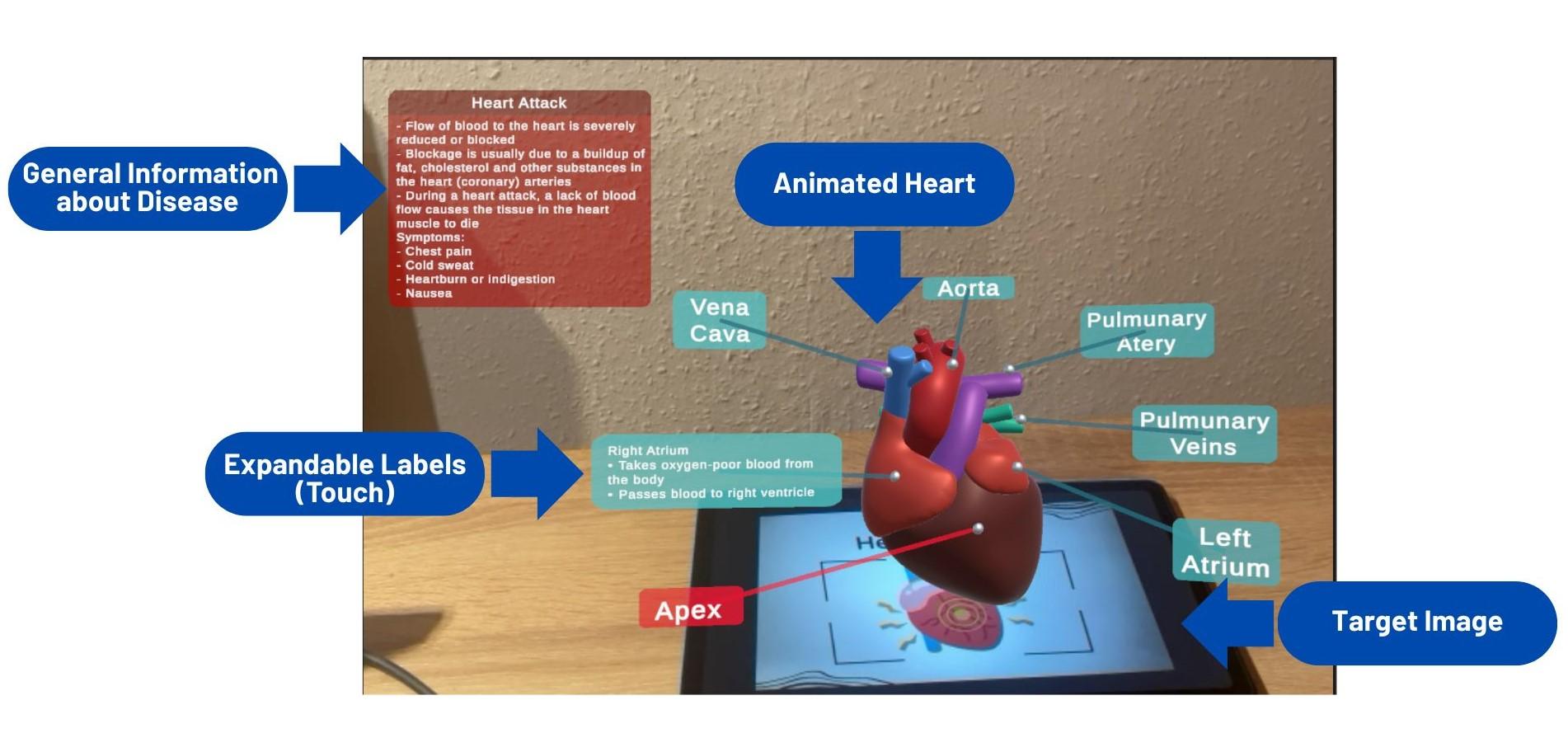
We developed the Interactive 3D Heart Anatomy Viewer, which is a tablet-based AR application that helps users explore the human heart and common heart diseases in an intuitive way. The application is designed for learners of all levels—from curious individuals to students and teachers—making heart anatomy more accessible and memorable.
How does the application work?
Users point the tablet’s camera at a printed image—kind of like scanning a QR code—that’s labeled with a specific heart condition, such as “heart attack” or “atrial fibrillation.” When recognized, the app overlays a 3D animated heart model in augmented reality (AR), showing how the heart behaves under that condition. Labels identify different parts of the heart, and a brief info panel explains the disease. Tapping on a label reveals more details about that heart part, which you can collapse again when you’re ready to move on.